Dear guests,
We are here in a cemetery that most of us did not know previously. I would like to take a look at how we and this statue got here.
It is spring 2021, the coronavirus pandemic has everything in its grip, it is cold and Mārtiņš has cancer. His strength is visibly declining. A week before his death, he takes me and Tabita to Limbiķi cemetery and tells us that he wants to be buried there, in the part where the residents of the Iļģi social care centre are buried. This decision is unexpected, but not really surprising, because it is a decision that characterises Mārtiņš and shows his attachment to these people. Respect for every person was important to him; the weak, the fragile, the marginalised were particularly close to his heart. Caring for them and giving them a place - that was Mārtiņš's Christian conviction, and this is how he fulfilled his pastoral role in the diaconal community.
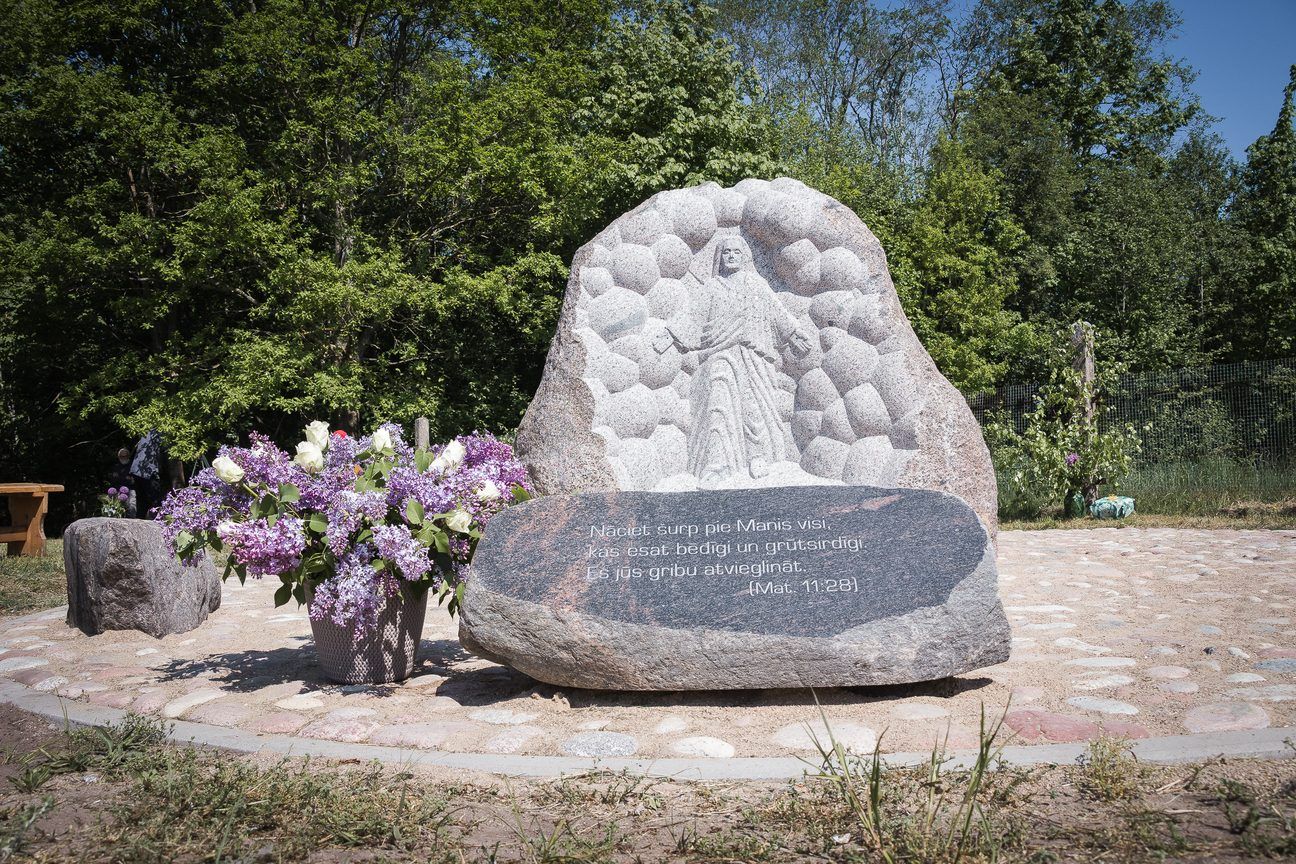
He also asks us to ensure that a statue of Jesus is erected in this part of the cemetery, inscribed with the words from the Gospel of Matthew: "Come to me, all you who labour and are heavy laden. I will give you rest." We can no longer talk about what this statue should look like. He leaves the responsibility for this to us.
Our mother Gita, Tabita and I have a lot of experience with graves and cemeteries, but we knew nothing about the process of creating a statue. Not to mention the creation of a statue of Jesus.
We remembered that Mārtiņš's wife Aija had worked with the sculptor Ojārs Feldbergs on a number of projects. And the sculpture park Pedvāle, which Ojārs created, has always been close to our hearts.
So after Mārtiņš's funeral, we went to Pedvāle to ask Ojārs for advice on how we could realise Mārtiņš's last wish. A week later, we unexpectedly received the news from Ojārs that he was ready to take on the task himself! We could only tell him what we didn't want: for example, a statue of Jesus in the style of Rio de Janeiro. But how to create a Jesus who is approachable, easy to understand in his message and accessible to everyone? We passed this responsibility on to Ojārs.
Ojārs met our naivety with calm and understanding - both in terms of the possible time frame and the costs. Over the past three years, we have accompanied Ojārs' work: Understanding the idea and location of the monument, the initial designs, the search for a suitable stone, the transport of the stone to Pedvāle, the search for the right representation of Jesus, the time-consuming creation of a model of the statue in clay, the casting of the model in plaster, the hard work of chiselling out the shape of the statue in rain, sun and frost, the meticulous elaboration of the statue, the coordination with the municipality, the preparatory work in the cemetery and finally the transport and installation of the statue.
The fundraising turned out to be easier than expected because so many were willing to support the cause. People who were touched by Mārtiņš's beliefs and his work, his friends and acquaintances who were moved by the idea of a statue of Jesus in the Limbiki cemetery, but also people who didn't know Mārtiņš at all but simply felt touched by this idea. Together we made his wish come true. Our heartfelt thanks to everyone who contributed!
During the creation of the statue, we realised that this project would be bigger than we had originally imagined. It is not a memorial to Mārtiņš, it is not a memorial to the people who are buried here, but it is a place for everyone, and especially for those whose hearts are heavy with sorrow and sadness. We hope it will become a place where people will pause for a moment to contemplate, find peace, and be encouraged.
Thank you!